Manufactured Scarcity vs Genuine Scarcity in Comics
Full Report
Learn how to identify genuine scarcity in comic books and avoid the common collecting trap of confusing rarity with long-term significance.
One of the most misunderstood concepts in comic book collecting is scarcity.
Collectors hear terms like "rare," "low print run," and "hard to find" so often that they can begin to sound interchangeable. In reality, they describe very different market conditions. Understanding those differences can mean the difference between acquiring a genuinely important comic and overpaying for a book whose appeal is based largely on artificial demand.
The distinction between manufactured scarcity and genuine scarcity has shaped the comic market for decades. It influences everything from Golden Age keys to modern retailer variants. More importantly, it often separates books that hold value over time from those that struggle once the excitement fades.
For collectors focused on building a thoughtful, historically grounded collection, learning to recognize that distinction is essential.
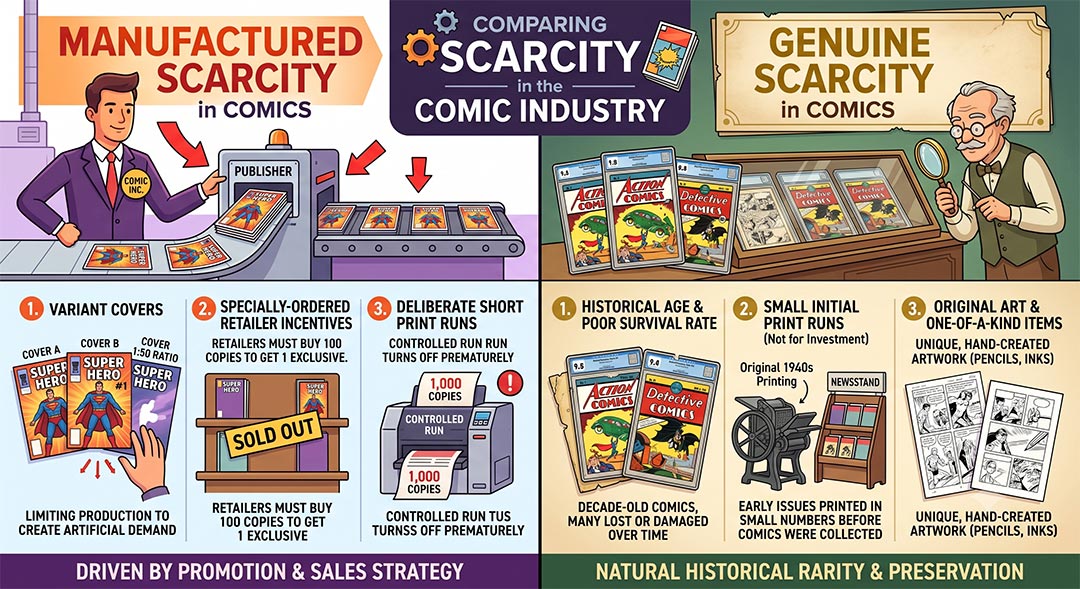
Genuine Scarcity vs. Manufactured Scarcity
What Is Genuine Scarcity?
Genuine scarcity occurs naturally. A comic becomes genuinely scarce when relatively few copies survive, remain available, or were distributed in meaningful quantities to begin with. The key factor is that the scarcity was not intentionally created as a marketing strategy.
Many Golden Age comics fall into this category. Publishers had little reason to preserve inventory, readers rarely treated comics as collectibles, and surviving copies were often discarded, damaged, or lost over time.
Consider books like Action Comics #1 or Detective Comics #27. Their value is not driven solely by character significance—very few surviving copies exist relative to the massive demand created by generations of collectors. That is genuine scarcity at work.
What Is Manufactured Scarcity?
Manufactured scarcity is different. It occurs when publishers, distributors, or retailers intentionally limit supply to create exclusivity. Modern comics provide countless examples. Retailer incentive variants, convention exclusives, limited print runs, and store-specific covers are all designed with scarcity in mind from the beginning.
There is nothing inherently wrong with this model, and some manufacturedly scarce books perform exceptionally well. However, the mistake collectors make is assuming scarcity alone guarantees long-term value. A comic can be extremely limited and still lack the historical significance necessary to sustain demand years later.
The Golden Rule: Scarcity matters. Demand matters more.
The Most Common Collecting Mistake
Many collectors focus entirely on supply while completely ignoring demand. Imagine a modern variant with only 500 copies printed. At first glance, that sounds impressive. Now compare it to a major Silver Age key that may have had hundreds of thousands of copies printed originally, but has spent sixty years being lost, damaged, discarded, and absorbed into permanent collections.
Which book is actually harder to acquire? The answer is often not as obvious as the original print run suggests. Collectors frequently confuse low production numbers with genuine market scarcity. The two are not always the same thing.
Low Print Runs Do Not Automatically Create Value
Rarity alone is not enough. History provides countless examples of low-print books that failed to become meaningful long-term collectibles because collectors ultimately seek significance.
A low-print variant tied to an unremarkable issue may generate excitement for a few months. A historically important first appearance, landmark storyline, or industry-changing comic can generate demand for decades. When evaluating scarcity, always ask a simple question:
"If this book were not rare, would collectors still care about it?"
Why Age Matters More Than Realized
Time acts as a natural filter. Every decade that passes reduces the number of surviving copies available to the market. Books are damaged, misplaced, upgraded, locked away in private collections, or removed from circulation entirely.
This process creates organic scarcity. That is one reason older keys often maintain demand through multiple market cycles. Their scarcity developed naturally over time rather than being engineered from the beginning. Age alone does not create value, but age combined with significance creates an incredibly powerful collecting foundation.
How Smart Collectors Evaluate the Market
Disciplined collectors typically evaluate three interconnected factors before allocating their budget:
Historical Significance: Why does the book matter? First appearances, origin stories, landmark creative runs, and industry-changing issues tend to attract enduring interest.
Long-Term Demand: Who wants the book today? More importantly, who is likely to want it ten years from now? Sustained, generational demand always outlasts temporary media hype.
True Availability: How difficult is the book to acquire in the specific grade you want? A comic can have a relatively high original print run and still be genuinely scarce in high-grade condition today.
Looking at all three factors together creates a much clearer picture than relying on raw print numbers alone.
The Bottom Line
Scarcity is one of the most powerful forces in comic book collecting, but it is also one of the most misunderstood. Some scarce comics are historically insignificant, while some historically significant comics are surprisingly available. The strongest long-term collectibles tend to combine both qualities: they matter to comic history, and they are genuinely difficult to obtain.
Manufactured scarcity can easily create short-term excitement. Genuine scarcity develops through time, history, survival rates, and sustained collector demand. The smartest collectors do not simply ask how many copies exist; they ask why the book matters, who wants it, and whether its scarcity is the result of authentic market forces or deliberate corporate decisions.