The Most Important Independent Comics Ever Published
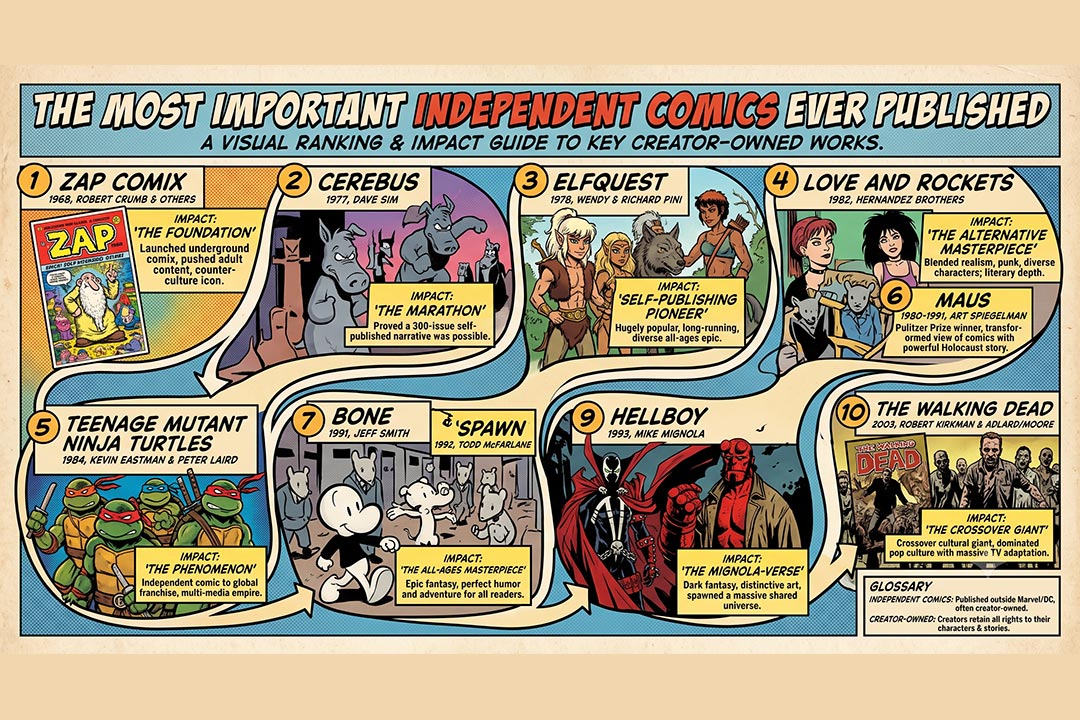
Full Report
Explore the independent comic books that changed the industry and left a lasting impact on creators, collectors, and comic book history.
When most collectors discuss the most important comic books ever published, the conversation usually begins with Marvel and DC.
That makes sense. Superman, Spider-Man, Batman, and the X-Men have shaped the hobby for generations.
But some of the most influential books in comic history were created outside the industry's two largest publishers.
Independent comics challenged traditional business models, proved creator-owned properties could succeed, introduced groundbreaking storytelling techniques, and helped redefine what comics could be. Many of today's publishing trends, creator rights discussions, and collector markets can be traced directly back to books produced far from the Marvel and DC spotlight.
If comic book history is viewed as a roadmap, these are the independent comics that changed the route.
Teenage Mutant Ninja Turtles #1 (1984)
No independent comic has demonstrated the power of creator-owned success more dramatically than Teenage Mutant Ninja Turtles #1.
What began as a self-published parody by Kevin Eastman and Peter Laird evolved into one of the most successful entertainment franchises in history.
The significance of this book extends beyond the turtles themselves. It proved that independent creators could compete with major publishers and build global brands from entirely original concepts.
For many aspiring creators, TMNT #1 became proof that success outside the traditional system was possible.
Cerebus #1 (1977)
Love it or criticize it, the importance of Cerebus cannot be ignored.
Dave Sim's ambitious independent series demonstrated that comics could sustain long-form storytelling on a scale previously associated with novels. More importantly, the book became a symbol of creator independence and self-publishing.
Cerebus helped fuel conversations about creator rights that continue to influence the industry today.
Its impact reaches far beyond the character itself.
Spawn #1 (1992)
Spawn #1 arrived at a pivotal moment in comic book history.
Published by the newly formed Image Comics, the issue became a statement of intent from creators determined to control their own intellectual property.
Todd McFarlane's creation quickly became one of the most successful independent superhero books ever published. More importantly, Spawn helped establish Image as a legitimate alternative to Marvel and DC.
The ripple effects of that shift are still being felt decades later.
Bone #1 (1991)
Few comics have earned the universal respect enjoyed by Bone.
Jeff Smith's fantasy epic combined humor, adventure, and emotional storytelling in a way that appealed to readers of all ages. Over time, Bone became one of the most celebrated independent comics ever created.
Its success demonstrated that independent comics could achieve both critical acclaim and commercial success without relying on superheroes.
That lesson remains important today.
Love and Rockets #1 (1982)
The Hernandez brothers helped expand perceptions of what comics could accomplish through Love and Rockets.
The series explored culture, family, relationships, and identity with a level of sophistication rarely seen in mainstream comics at the time.
Its influence on alternative comics and literary graphic storytelling cannot be overstated.
Many creators who followed would build upon foundations established by this groundbreaking series.
The Walking Dead #1 (2003)
Before The Walking Dead became a television phenomenon, it was an independent black-and-white comic published by Image Comics.
Robert Kirkman proved that long-form creator-owned storytelling could attract massive audiences without support from the major publishers.
The series revitalized interest in horror comics and demonstrated that creator-owned properties could become multimedia franchises on a global scale.
Its success changed how publishers and creators viewed independent comics.
Usagi Yojimbo #1 (1987)
Stan Sakai's rabbit ronin has become one of the most respected characters in comic history.
What makes Usagi Yojimbo remarkable is its consistency. Decades after its debut, the series remains a benchmark for storytelling, craftsmanship, and creator ownership.
Few independent comics have maintained such a high standard for so long.
Its longevity alone makes it historically significant.
Elfquest #1 (1978)
Long before fantasy became a dominant force in popular culture, Elfquest was building a devoted readership.
Created by Wendy and Richard Pini, the series demonstrated the potential for independent fantasy comics and developed one of the most loyal fan communities in the medium.
Its influence can be seen in countless fantasy comics that followed.
Why These Books Matter
The common thread connecting these comics is not simply popularity.
It is independence.
Each of these books challenged assumptions about what comics could be, who could create them, and how they could reach readers. Some transformed creator rights. Others redefined storytelling. Several proved that independent publishing could produce global franchises capable of rivaling anything from Marvel or DC.
Their influence extends far beyond sales figures or market values.
They changed the industry itself.
The Bottom Line
Marvel and DC may dominate comic book history, but they do not own it.
Independent comics have repeatedly pushed the medium forward by introducing new ideas, new business models, and new storytelling approaches. Without books like Teenage Mutant Ninja Turtles #1, Cerebus #1, Spawn #1, and Bone #1, the comic industry would look very different today.
For collectors interested in understanding the full history of comics, these books are not side notes.
They are essential chapters.