The Comic Short Box Blueprint: The Hidden Engineering Behind Every Collector's Favorite Storage Box
Full Report
The Anatomy of the Perfect Comic Short Box: Learn the engineering behind comic short boxes, why every fold and measurement matters, and how proper storage protects your comic book collection for decades.
Walk into almost any comic shop in North America and you'll find them stacked against the wall, tucked beneath tables, or filled with decades of comic book history. They are as familiar to collectors as backing boards and Mylar bags. Yet despite their ubiquity, few collectors ever stop to consider the engineering behind the humble comic short box.
At first glance, it's just folded corrugated cardboard. But every crease, tab, fold, and dimension has been carefully designed to solve a specific problem. A properly engineered comic storage box isn't simply a container. It's a structural system built to protect hundreds or even thousands of dollars worth of collectible comics from crushing, shifting, tearing, and long-term wear.
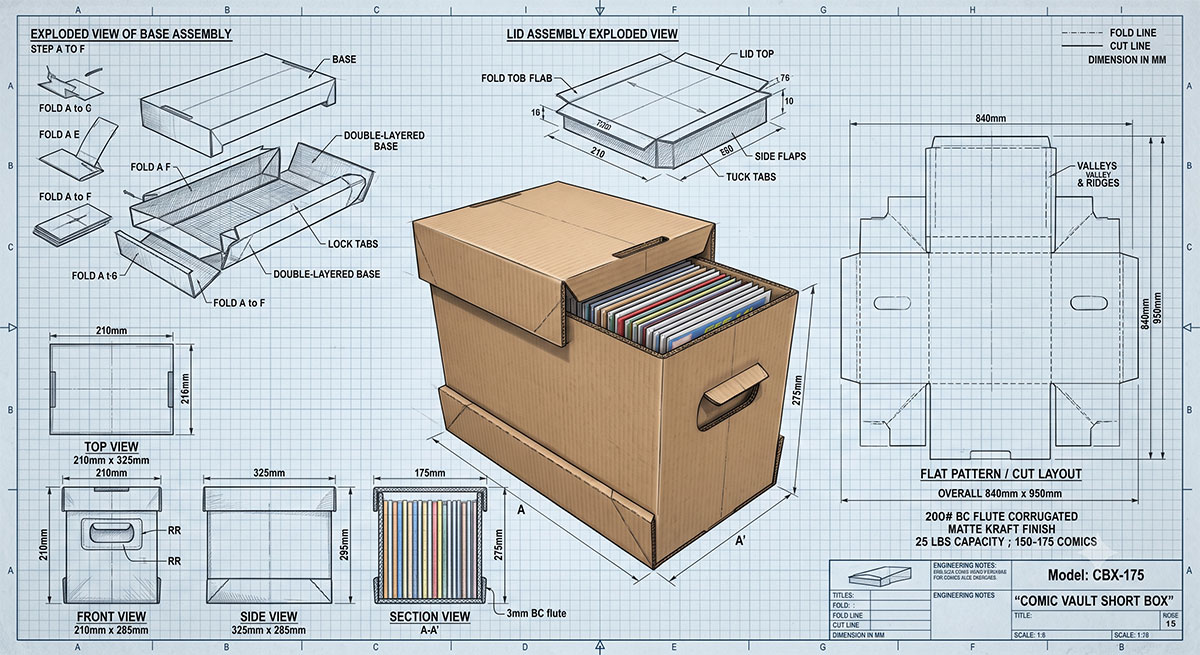
The blueprint above reveals something most collectors never see: a comic short box is an engineered product. Every measurement exists for a reason, and understanding that design can help you make better decisions about storing and preserving your collection.
More Than Just a Cardboard Box
Comic collectors spend countless hours hunting key issues, organizing runs, cataloging collections, researching values, and protecting books with archival bags and boards. Ironically, many give very little thought to the box that ultimately supports the entire collection.
That box becomes responsible for protecting:
Hundreds of comic books
Tens of thousands of pages
Years of collecting
Significant financial value
Irreplaceable memories
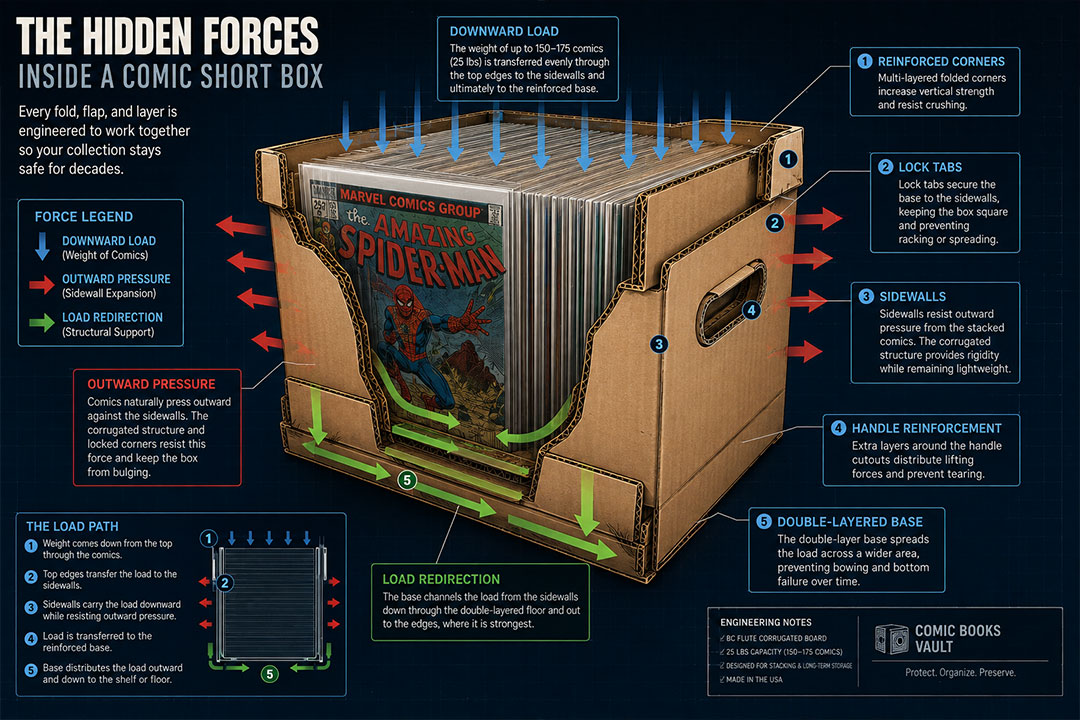
When fully loaded, a typical short box can weigh between 20 and 30 pounds depending on paper stock, bags, boards, and whether magazines or annuals are included. That's a tremendous amount of concentrated weight resting on folded cardboard.
Without thoughtful engineering, the box would quickly fail.
Why Short Boxes Became the Collector Standard
For decades, long boxes dominated comic collecting.
Comic shops loved them because they maximized storage efficiency. Dealers could transport large inventories while using fewer containers.
Collectors eventually discovered the downside.
A fully loaded long box often exceeds 50 pounds.
That creates several problems:
Difficult to lift safely
Increased strain on box seams
Greater risk of bottom collapse
More likely to bow over time
Harder to organize
Short boxes solved nearly all of these issues.
Although they hold fewer comics, they're significantly easier to move, reduce stress on the cardboard, and make organizing collections far more manageable.
Today, many experienced collectors exclusively use short boxes despite requiring more of them.
Looking at the Blueprint Like an Engineer
Most collectors see a finished box.
An engineer sees load paths.
The exploded assembly drawing immediately reveals that the box isn't built from a single layer of cardboard. Instead, the structure relies on multiple folded sections working together.
Every fold increases rigidity.
Every overlap distributes force.
Every locking tab transfers weight.
This transforms relatively lightweight corrugated cardboard into a surprisingly strong structural container.
It's remarkably similar to architectural engineering.
A bridge isn't strong because of the amount of steel it contains.
It's strong because of how that steel is arranged.
Comic storage boxes follow exactly the same principle.
The Double-Layer Bottom Is the Hero
If there's one feature doing the most work, it's the double-layered bottom.
The blueprint clearly illustrates multiple overlapping panels creating a reinforced floor.
Why?
Because gravity never takes a day off.
A fully loaded short box may contain 150 to 175 comics, all pressing downward continuously.
Without reinforcement:
the bottom would bow
corners would spread
seams would separate
handles would distort
eventually the entire box could fail
The overlapping layers distribute the load across the entire floor rather than concentrating it along a single seam.
This dramatically increases structural strength without dramatically increasing manufacturing cost.
Why Corrugated Cardboard Is So Strong
Most people think cardboard is weak.
Engineers know better.
The blueprint specifies BC flute corrugated construction.
Corrugated board consists of:
an outer liner
a fluted middle section
an inner liner
Those flutes function similarly to the webbing inside an I-beam.
They resist compression while remaining relatively lightweight.
The air pockets also provide:
impact absorption
improved rigidity
insulation against temperature changes
better stacking performance
Simply increasing cardboard thickness wouldn't produce the same strength-to-weight ratio.
The geometry is what creates the strength.
Every Fold Serves a Purpose
It's tempting to think many of the folds are simply there so the box can be assembled.
They're not.
Each fold performs multiple structural jobs.
The corner folds:
reinforce vertical edges
reduce twisting
prevent spreading
The side panels:
stabilize the walls
resist outward pressure
The lid flaps:
reduce deformation
keep dust out
improve stacking alignment
The lock tabs:
eliminate the need for adhesives
transfer structural loads
keep the base square
Nothing exists by accident.
Why the Handles Aren't Just Holes
The handle cutouts deserve far more appreciation than they receive.
Without reinforcement, punching large holes into the side of a loaded box would create immediate failure points.
Instead, notice how the surrounding folds strengthen the area.
This distributes lifting forces across multiple layers instead of a single thin edge.
That engineering prevents tearing when carrying a heavy collection.
If you've ever picked up an overloaded moving box and watched the handles rip through the cardboard, you've witnessed what happens without proper reinforcement.
Dimensions Matter More Than You Think
One of the most overlooked aspects of comic storage is internal clearance.
The dimensions of a short box aren't arbitrary.
They've evolved around decades of comic publishing standards.
The interior must comfortably accommodate:
modern comics
Silver Age books
bagged comics
boarded comics
Mylar sleeves
slightly oversized annuals
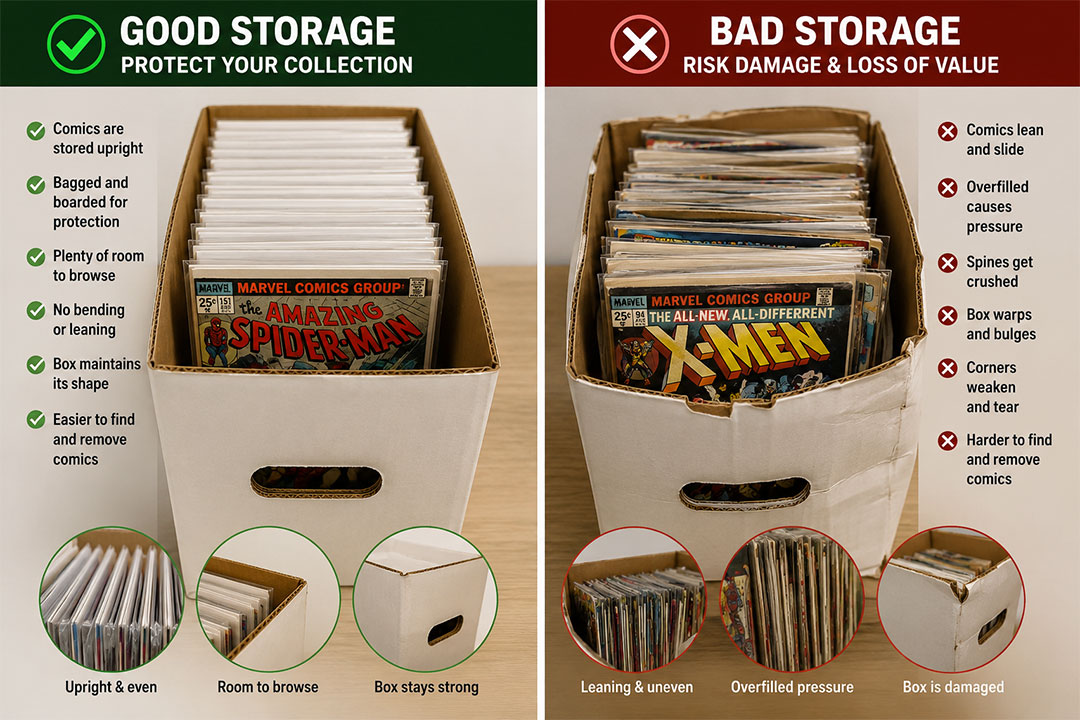
Too much room allows books to lean.
Too little room damages edges during insertion.
The ideal fit keeps comics upright while allowing easy browsing.
Good storage is a balance between stability and accessibility.
Stackability Is an Engineering Problem
Collectors rarely own one box.
Many eventually own dozens.
Some own hundreds.
That means every box becomes part of a larger structural system.
The lid isn't simply a cover.
It functions as a load distribution platform.
When properly stacked, weight transfers downward through reinforced corners instead of crushing the center panels.
Improper stacking places stress exactly where the cardboard is weakest.
A few simple habits dramatically improve long-term storage:
Avoid stacking boxes excessively high.
Store boxes on sturdy shelving whenever possible.
Keep stacks level.
Rotate heavily accessed boxes periodically.
Replace boxes that show signs of structural fatigue.
Moisture Is Still the Greatest Enemy
Even the best-engineered storage box has one unavoidable weakness.
Water.
Corrugated cardboard loses strength rapidly when saturated.
Humidity creates additional problems:
softening fibers
encouraging mold growth
attracting pests
warping boards
damaging comic paper
Collectors should maintain storage environments around:
60 to 70°F
40 to 50 percent relative humidity
Avoid garages, damp basements, and unconditioned attics whenever possible.
The strongest storage box in the world cannot overcome poor environmental conditions.
Engineering Protects Collections, Not Just Cardboard
One lesson becomes obvious after studying the blueprint.
The goal isn't to build a strong box.
The goal is to protect what's inside it.
Every engineering decision ultimately serves the comic books.
The reinforced bottom protects against collapse.
The rigid walls prevent bending.
The locking corners resist spreading.
The lid shields against dust and light.
The handles encourage safer lifting.
Each feature works together as part of a complete preservation system.
Looking Beyond the Box
Storage is only one piece of responsible collecting.
Protecting a collection also means knowing exactly what you own.
Many collectors have spent years organizing long boxes only to discover they can't quickly answer simple questions:
Which issues am I missing?
Which books need upgrading?
Where is that first appearance?
Which variants do I own?
What is my collection worth?
Physical protection and digital organization go hand in hand.
One safeguards the condition of your comics.
The other safeguards your knowledge of them.
Together, they create a collection that's easier to preserve, insure, enjoy, and eventually pass on.
Final Thoughts
The comic short box is one of the most overlooked pieces of engineering in the hobby.
Collectors often focus on grading, key issues, preservation supplies, and market values while ignoring the structure that physically supports their collection every single day.
The blueprint tells a different story.
Every fold, every tab, every reinforced corner, and every carefully chosen dimension exists because someone solved a real problem. The result is a deceptively simple storage system capable of safely protecting hundreds of comics while remaining affordable, lightweight, and easy to assemble.
The next time you build a short box, take a closer look before folding the first flap.
You're not just assembling cardboard.
You're assembling decades of engineering designed to protect decades of comic book history.
About Comic Books Vault
Comic Books Vault helps collectors organize, identify, and preserve their comic collections through intelligent collection management, AI-powered tools, and educational resources built for collectors who want to protect both the value and the history of their comics. Because preserving a collection starts long before the next key issue goes into the box.